
How to fly further in Soar
The rules the game never tells you, taken from the physics that actually runs
By Crown Games
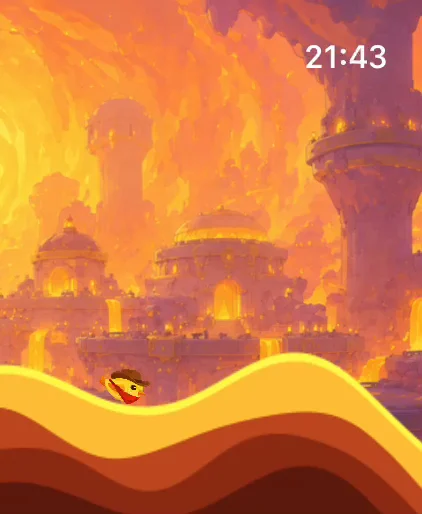
Soar looks like a one-button game, and it is. Hold to dive, release to fly. What it does not tell you is that most of the rules reward restraint, and the single most common mistake is holding the button too long.
This is our game, so these are not observations from playing it. They are the rules from the physics that ships.
1. Height is never given to you
There is no launch bonus. When the bird leaves a crest, the game adds nothing: the height you get is entirely the momentum you carried into the ramp.
That one decision drives everything else. If you want to go higher, the answer is never “jump better”. It is always “arrive faster”.
2. Holding dive on a downhill has a timer
Holding dive while grounded on a descent pushes the bird along the slope. It is the main way you build speed, and it works for about 0.8 seconds.
After that a drain takes over, ramps to full in another 0.4 seconds, and it is strong. Long holds do not just stop helping, they actively cost you speed.
Tap it in bursts down a long slope instead of leaning on it. This is the single biggest difference between a run that stalls at the third hill and one that does not.
3. Mashing does nothing
Each press adds a one-shot downward kick, and that kick has a half-second cooldown. Tapping five times in a second gives you exactly one kick, same as tapping once.
A sustained hold counts as one press, so it is unaffected. There is no input speed that beats good timing.
4. Going fast makes the boost pointless
The downhill boost scales down as you approach a top speed of 7800, hitting zero when you get there. The drain from rule 2 does not scale down.
So at high speed, holding dive is all downside. Once you are genuinely fast, the button is for steering your line into the next descent, not for going faster.
5. Land along the slope, not into it
Landing is where runs are won and lost. The game measures the angle between your velocity and the surface you touch:
- Within about 72 degrees of the slope, you surf. You keep your speed.
- Worse than that, you slam, and you keep 75% of it.
Losing a quarter of your speed once is survivable. Doing it three hills in a row ends the run.
6. A perfect landing is a speed gain
This is the one that separates good runs from long ones. A clean, fully aligned touchdown onto a downslope does not just preserve your speed, it multiplies it by up to 1.10.
That is a 10% gain, per landing, and it does not compound within a single landing. But chaining clean landings can push you past the 7800 cap that the downhill boost can never take you through on its own.
The ceiling of the game is not a speed number. It is how many perfect carves you can string together.
7. Above 400 speed, hills are free
Climbing normally costs you friction. That friction is waived entirely at or above a speed of 400.
Below it you are grinding uphill and paying for every metre. Above it you are coasting on momentum you earned, and the hill takes nothing. Keeping your speed over that line matters more than any individual jump.
8. Going up, and the trick for going down
Vertical transitions have two stages. Climb to an altitude of 720 and the up chevron locks. Rise another 540 above that lock point and the transition fires on its own. Drop 200 below the arm altitude and it cancels.
The interesting part is the window in between. While the chevron is locked and you are still rising, pressing dive flips the whole thing: instead of climbing to the Clouds, you punch down through the ground toward the Underground.
Once you start falling, that window shuts. So the down route is not a separate input, it is the same climb with a dive at the top of it.
Ranked mode never goes vertical at all, so no chevron will ever arm there.
The short version
Arrive fast, tap rather than hold, and land flat along the descent. Most players lose speed to the drain and to bad landing angles without ever knowing either exists.
Soar is free on the App Store. If you want to know what else is on the wrist, we counted every game with an Apple Watch component: 4,599 of them, and not many fly.
Frequently asked
Why does my speed drop when I hold dive on a downhill?
- The downhill boost only lasts about 0.8 seconds. Past that a drain takes over and ramps to full strength in another 0.4 seconds, and it is strong enough to feel. Holding dive down a long slope is slower than tapping it in bursts.
Does tapping faster make you dive harder in Soar?
- No. The press impulse has a half-second cooldown, so only one lands per 0.5 seconds no matter how fast you tap. A sustained hold is a single press and is unaffected.
How do you get more height off a crest in Soar?
- Speed. There is no launch bonus at all, so height is purely the momentum you carry into the crest. If you want to go higher, go faster down the slope before it.
How do you fly up to the Clouds or down to the Underground?
- Climb to 720 altitude and the up chevron locks. Rise another 540 above that lock point and the transition fires by itself. To go down instead, press dive while the chevron is locked and you are still rising.
Why does the up chevron never appear in Ranked?
- Ranked is horizontal only by design. Vertical transitions are disabled in that mode, so no chevron ever arms.
Keep reading
Hold to dive, release to fly: a momentum flying game that turns one tap into a world of 17 biomes.
Where the game actually runs decides how it feels on your wrist
The best arcade and action games that really play on Apple Watch: shooters, platformers, one-tap games and more, filtered from 4,599 watch apps.
The 12 best Apple Watch games of 2026, ranked by category: native watchOS games worth installing, free and paid. Prices verified August 2026.